

Fiberglass is one of the best choices for solid front doors in humid climates, while thermally broken aluminum is particularly well suited to large glass patio doors and wide exterior openings. Both handle moisture better than traditional wood, but they differ in thermal performance, structural design, and cost.
Understanding which door materials are best for humid homes helps you choose the right option. This guide compares five door materials, explains their limitations, and covers the finishes, hardware, and glazing that matter in humid and coastal environments.
Key Takeaways
- Fiberglass: A reliable option for solid entry doors, with low thermal expansion and strong moisture resistance.
- Thermally broken aluminum: A premium solution for large glass patio doors, bifold systems, and contemporary exterior openings.
- Vinyl: An affordable, moisture-resistant choice, although large frames can experience significant heat-related expansion.
- Steel: Offers strength and security but needs suitable corrosion protection.
- Natural wood: Requires regular sealing and maintenance to manage moisture-related movement and deterioration.
Why Humidity Ruins Traditional Doors
Wood reacts to moisture in the air, and repeated exposure can affect its dimensions, finish, and ability to operate smoothly.
According to the USDA Forest Products Laboratory’s Wood Handbook, Chapter 4: Moisture Relations and Physical Properties of Wood, wood is hygroscopic, meaning it absorbs or releases moisture depending on the surrounding temperature and relative humidity.
Over time, its moisture content tends toward an equilibrium with the surrounding environment. This is known as equilibrium moisture content (EMC).
When humidity rises, wood can expand. When conditions become drier, it can shrink again. Repeated changes create several practical issues:
- Swelling: Door panels expand and become difficult to close.
- Frame friction: The door rubs against the jamb, making operation harder.
- Paint damage: Repeated movement causes cracks in the protective finish.
- Rot and mold: Prolonged moisture exposure can encourage fungal deterioration, particularly around poorly protected edges.
- Hardware misalignment: Changes in door dimensions can affect hinges, latches, and locking points.
These are common wood doors in humid climate problems, especially when the bottom edge or exposed joints have not been properly sealed.
The solution is not simply applying another coat of paint. Wood doors need appropriate preparation, edge protection, and maintenance to handle changing moisture conditions.
Best Front Door Material and Best Exterior Door Material for Humid Homes
The right material depends on whether the door is a solid entry panel, a large glass patio system, or an interior partition. The comparison below considers moisture resistance, thermal movement, maintenance, and typical applications.
Door Material Comparison for Humid Climates
| Material | Swelling Risk | Thermal Stability | Rot Resistance | Investment |
| Fiberglass | Very low | Excellent | Excellent | Moderate–High |
| Thermally broken aluminum | None from moisture absorption | Good; expansion must be accommodated | No rot; corrosion protection required | Premium |
| Vinyl (uPVC) | None from moisture absorption | Fair for large, sun-exposed frames | Excellent | Budget |
| Steel | None from moisture absorption | Good | Requires rust protection | Low–Moderate |
| Solid wood | High | Sensitive to moisture changes | Requires ongoing protection | High |
Fiberglass: A Stable Choice for Front Entry Doors
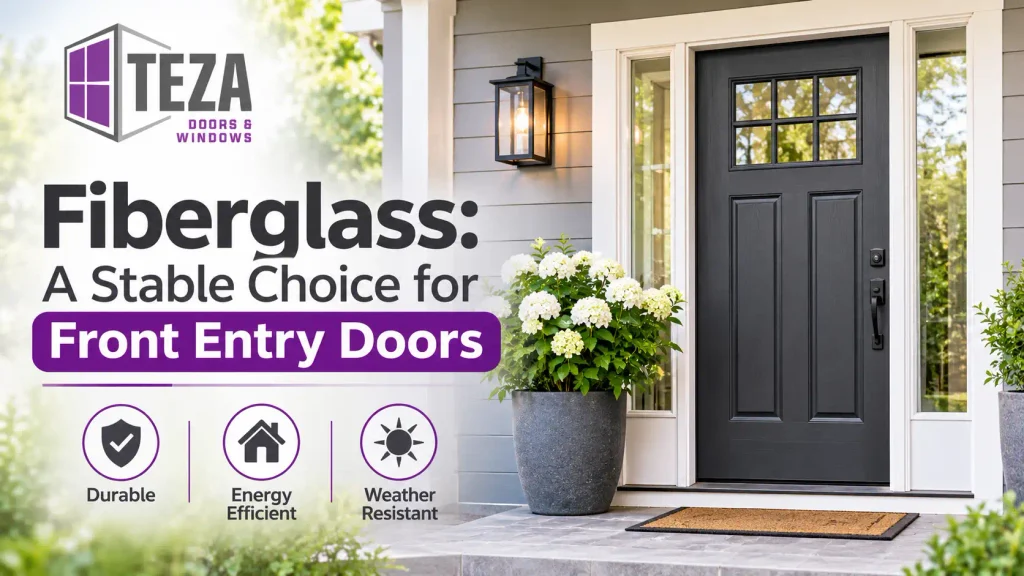
When comparing the best front door for humidity, fiberglass stands out for its moisture resistance, dimensional stability, and low maintenance.
According to Pella EFCO Commercial Solutions, fiberglass frames expand approximately three times less than aluminum in ASTM-based testing, helping maintain stable connections around glazing and seals.
Key benefits include:
- Resistance to swelling and rot.
- Good insulation performance.
- Low maintenance and corrosion resistance.
- Wood-grain finishes for traditional styles.
When considering which door materials are best for humid homes, fiberglass is particularly suitable for solid front entries. Explore TEZA’s guide to different types of entry doors to compare available options.
Thermally Broken Aluminum: Best for Large Exterior Openings
Aluminum is particularly useful when a project calls for large glass panels, narrow sightlines, or wide folding and sliding configurations. Unlike wood, aluminum does not absorb atmospheric moisture or develop wood rot. Its structural strength makes it suitable for larger door systems that require a rigid frame.
For homeowners looking for the best exterior door for a humid climate, thermally broken aluminum is a practical choice for large glass, sliding, and bifold openings.
However, aluminum expands more with temperature changes than fiberglass. The Pella EFCO technical material cited above reports approximately three times the thermal expansion of fiberglass.
This does not make aluminum unsuitable for humid climates. It means frame engineering, glazing allowances, installation, and thermal performance need attention.
What Does a Thermal Break Do?
A thermal break is a low-conductivity barrier, commonly made from polyamide, placed between the interior and exterior aluminum sections. It reduces heat transfer through the frame, helping maintain a more stable interior surface temperature and lowering the likelihood of condensation.
It does not eliminate condensation under every indoor temperature and humidity condition.
TEZA’s 65 Series French Door provides a useful example of this construction. Its published specifications include:
- A polyamide thermal break.
- Double-pane tempered glass with argon gas.
- Low-E2 and Low-E4 glass options.
- A three-point locking system.
- A powder-coated finish.
For homeowners considering aluminum bifold doors, thermally broken systems offer a practical combination of large-format design, structural support, and improved thermal performance.
Why Vinyl and Steel Doors Have Limitations
Vinyl and steel can both work in certain humid environments, but their limitations become more noticeable in demanding exterior applications.
Vinyl (uPVC) Doors
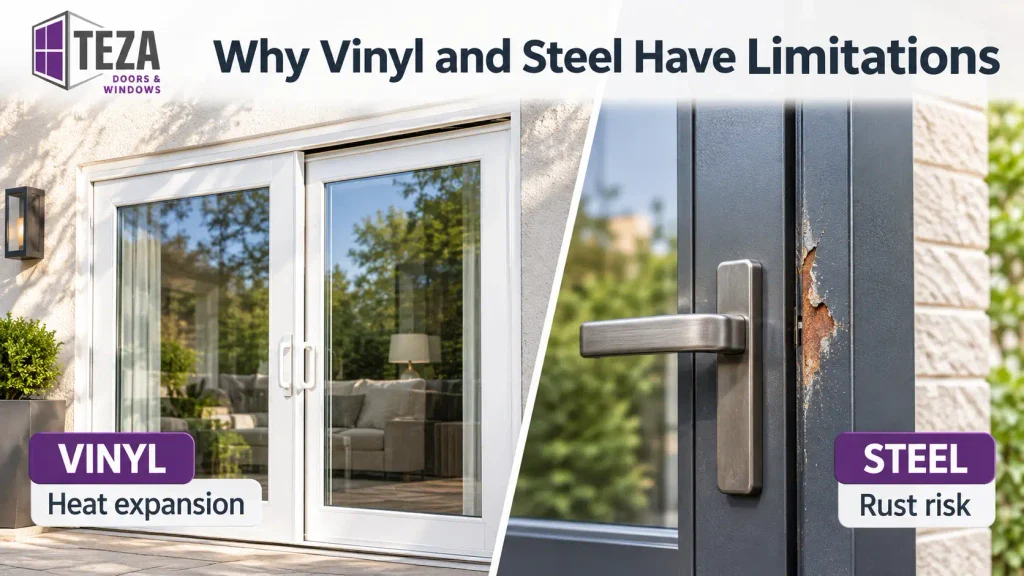
Vinyl does not absorb moisture or rot. Its main drawback is its relatively high thermal expansion.
The material can expand considerably under direct sunlight, making large frames more challenging to keep properly aligned. Reinforcement, frame dimensions, and installation quality become especially important.
It is generally better suited to smaller openings and budget-conscious projects than oversized architectural patio systems.
Steel Doors
Steel provides strength and security, but damaged paint, exposed edges, and vulnerable joints can allow rust to develop.
A well-protected steel door can perform reliably, particularly in sheltered locations. However, coastal environments require more attention to its finish and maintenance.
Best Interior Doors for Humid Rooms and Pool Houses
Interior doors face different moisture conditions from exterior entry systems. Bathrooms, laundry rooms, indoor pool enclosures, and sunrooms can all create localized high-humidity environments.
For the best interior doors for high humidity, consider the actual exposure rather than choosing a material based only on its appearance.
Suitable options include:
- Standard aluminum frames: Useful for interior glass partitions and doors in moisture-prone spaces.
- Glass doors: A practical choice for pool enclosures and bathrooms because glass does not absorb moisture.
- Solid composite doors: Suitable for homeowners who want a conventional door appearance with better moisture resistance than many standard wood constructions.
Hollow-core wood doors are less suitable for areas with frequent moisture exposure because their edges and internal construction may deteriorate when exposed to repeated humidity changes.
One important detail concerns indoor pool rooms. The door separating a pool enclosure from the rest of the house may experience significant differences in temperature and humidity across its two sides. Depending on the building envelope and expected conditions, thermal performance may matter even for this transition.
Essential Hardware and Glass for Humid Climates
Choosing a suitable frame is only part of the decision. Hardware, weatherseals, and glazing also influence how well the complete door system handles moisture.
Stainless Steel: 304 vs. 316
Stainless steel grades are not equally resistant to chloride exposure.
Type 316 contains molybdenum, which improves its resistance to chloride-related pitting and crevice corrosion compared with Type 304.
The Nickel Institute’s technical guidance on stainless steel in natural waters discusses the performance of stainless steel grades in freshwater, chloride-containing water, and seawater.
For hardware exposed to coastal salt deposits, 316 is generally the more suitable choice. Type 304 can be appropriate for many inland applications with ordinary atmospheric exposure.
However, 316 is not completely corrosion-proof. Regular cleaning and appropriate component selection still matter.
Galvanic Corrosion: When Different Metals Touch
Another issue in coastal installations is galvanic corrosion.
According to The Construction Specifier’s explanation of galvanic corrosion, contact between different metals in the presence of moisture containing salts or pollutants can accelerate corrosion in one of them.
For example, aluminum components connected directly to certain dissimilar metal fasteners may be vulnerable when salt-laden moisture creates an electrical path.
Suitable insulating washers, separation materials, compatible fasteners, and protective coatings help reduce this risk.
Weatherseals and Double-Pane Glass
Weatherseals limit air and water leaks, while double-pane Low-E glass reduces heat transfer and condensation risk. TEZA explains the benefits in its guide to insulated double glazing.
According to ENERGY STAR’s NFRC rating guide, condensation resistance is rated from 0 to 100, with higher scores indicating better resistance.
However, even glass with a high condensation resistance rating may develop condensation under certain indoor temperature and humidity conditions.
Condensation on Glass: Is Your Door Leaking or Sweating?
Moisture on glass does not automatically indicate a failed door seal.
There are two different situations:
- Surface condensation: Warm, humid indoor air meets a cooler glass surface, causing water droplets to form.
- Failed insulated glass seal: Fog or moisture appears between the glass panes, indicating that the sealed unit may no longer be functioning properly.
The distinction matters because the solutions are different. Surface condensation may require better humidity control or improved thermal performance, while moisture between panes usually requires attention to the insulated glass unit.
Coastal Humidity vs. Inland Humidity: What Changes?

A door exposed to coastal salt fog faces different challenges from one installed in an inland area with high atmospheric humidity.
Along the Southern California coast, marine moisture can leave chloride deposits on exterior frames and hardware. Inland homes may experience more direct sunlight and temperature fluctuations without the same level of airborne salt exposure.
The Construction Specifier’s guide to aluminum finishes in coastal areas explains why location, exposure, and protective finish selection matter when specifying architectural aluminum.
Understanding AAMA 2604 and 2605
According to the Powder Coating Institute (PCI), the 2022 editions of the AAMA coating specifications included the following exposure requirements:
Humidity Exposure:
- AAMA 2603: 1,500 hours.
- AAMA 2604: 3,000 hours.
- AAMA 2605: 4,000 hours.
Salt Spray (G85):
- AAMA 2603: 1,000 hours.
- AAMA 2604: 1,500 hours.
- AAMA 2605: 2,000 hours.
How to Protect Existing Doors from Moisture
Even a well-designed door needs routine maintenance. These four steps help reduce avoidable moisture damage.
- Seal all six sides of wood doors: Protect the front, back, top, bottom, and both vertical edges with a compatible finish.
- Control indoor humidity: Use suitable ventilation or dehumidification in bathrooms, laundry rooms, and indoor pool areas.
- Inspect exterior caulking: Check perimeter joints regularly and replace cracked or separated sealant.
- Clean exterior metal frames: Coastal homeowners should wash salt deposits from exposed metal surfaces with fresh water and follow the manufacturer’s cleaning instructions.
For additional maintenance advice, see TEZA’s guides on keeping bifold doors from sticking and weatherstripping sliding patio doors.
Choose the Right Door for Your Climate
When deciding which door materials are best for humid homes, the most important factor is matching the material to the door’s intended use. Fiberglass is a strong choice for solid front entries, while thermally broken aluminum is particularly suitable for large glass patio systems and contemporary exterior openings.
If you’re shopping for aluminum patio doors in Southern California, TEZA offers several aluminum systems designed for different residential applications.
For example, its 75 and 85 Series bifold doors feature a thermally broken frame when configured with a high track. The low-track option is not thermally broken. Both series also offer powder-coated finishes and insulated glazing options. Homeowners in hurricane-prone regions can also explore the TEZA HR Series bifold door with PVB laminated glass and review the company’s hurricane-rated certification information.
Explore TEZA’s aluminum door collections or contact the team to discuss the right configuration for your project.
TEZA Doors and Windows Showroom
- Van Nuys: 8210 Haskell Ave, Van Nuys, CA 91406 (Open Monday–Friday, 8:30 AM–5 PM).
- Santa Ana: 1544 E Warner Ave, Santa Ana, CA 92705 (Opening Soon).
- Phone: (818) 818 6001.
Visit the Van Nuys showroom to explore available door systems and discuss your home’s architectural and climate requirements.
By TEZA Doors and Windows Architectural Product Specialist
Frequently Asked Questions
Does aluminum rust in high humidity?
No. Aluminum does not develop iron rust, but it can corrode when its protective oxide layer or coating is compromised, particularly in coastal salt exposure.
Do fiberglass doors warp?
Fiberglass is dimensionally stable and expands less than aluminum under temperature changes. However, poor installation, product quality, and environmental conditions can still affect a complete door assembly.
Will a swollen wood door go back to normal?
Sometimes. If swelling is temporary, the door may return closer to its original dimensions as moisture levels fall. Permanent damage, rot, or finish failure may require repair or replacement.
Are aluminum doors okay near the ocean?
Yes, provided they have suitable corrosion protection, compatible hardware, and appropriate installation. Marine exposure makes coating quality and maintenance especially important.
Can humidity cause mold on a door?
Yes. Persistent moisture can support mold growth on contaminated surfaces, particularly around wood edges, seals, and poorly ventilated areas. Moisture control and regular cleaning help reduce the risk.
What Is the Strongest Material for a Front Door?
Steel is generally the strongest option for a front door, offering excellent security and impact resistance. Fiberglass is also durable and provides better moisture resistance with less maintenance.
What Are the Best Exterior Doors for the Money?
Fiberglass and steel doors offer good value. Fiberglass provides insulation and moisture resistance, while steel is more affordable and secure. Thermally broken aluminum is worth considering for large glass openings.

Leave a Reply